I thought I knew the music,
I’d practiced every part.
I had a little repertoire,
And knew most things by heart.
I watched the way you moved with me,
I listened when you sighed,
And usually I knew just when
To linger or to glide.

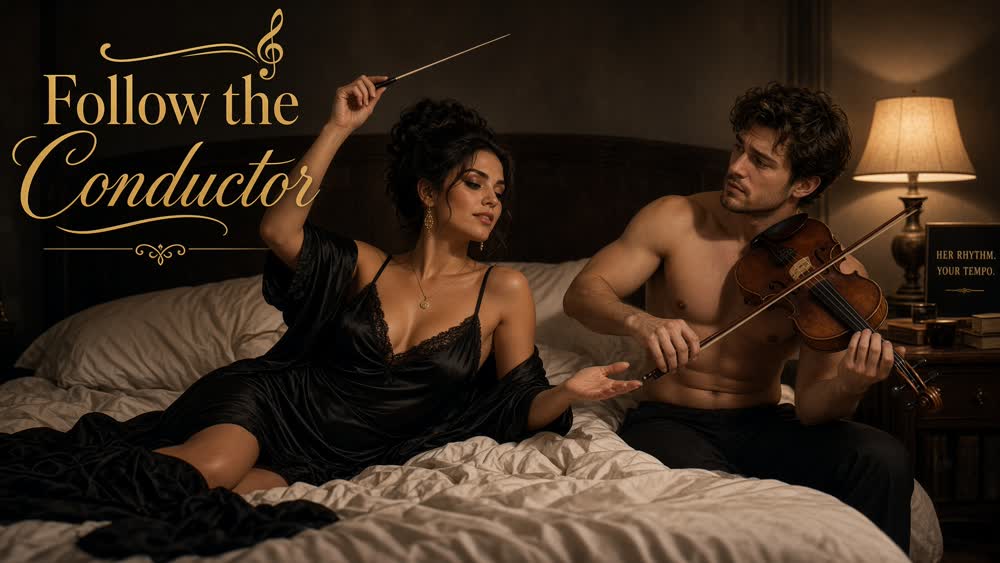
But then you raised a finger
Like a maestro with her score:
“A little softer there, please…
Yes… now give me just a little more.”
I said, “But just last Tuesday
You loved it when I played this way.”
You smiled and said, “That was Tuesday.
We’re playing something else today.”

[Chorus]
So I follow the conductor,
Every motion, every sign:
Faster, slower, hold the rhythm,
then you change your mind.
Pianissimo… crescendo…
“Stay right there—yes, that’s the spot.”
I’m a very willing musician,
I just play the notes I’ve got.

I keep a whole collection
Of techniques inside my head:
Little riffs and combinations,
Things remembered from the bed.
Some are tender, some are playful,
Some have earned a grand review—
But there’s no guaranteed selection
That will always work for you.

For quite a while I had it—
Every measure seemed just right.
You were breathing with the rhythm,
Everything was sounding tight.
Then suddenly your hand came up:
“No, slower now… not quite.”
What worked so well a minute back
no longer delights.
|
[Chorus]
I try to follow the conductor,
Working hard to catch the beat;
Every phrase builds expectation—
Then the downbeat moves its feet.
We hold the tension, change the rhythm,
Make me wait for the release;
Just when I think we’re resolving,
You change your mind and change the key.

And that’s the thing that gets me:
Same musician, same old hands,
Same beloved instrument before me—
Still, the music makes new demands.
One night you want a ballad,
Next time something with more drive.
It’s amazing how much music
One small orchestra can hide.

Now my part is fairly simple.
My score would fit upon a card:
“Show up eager, pay attention,
And occasionally work hard.”
But yours has markings in the margins,
Changes penciled everywhere.
And somehow every new revision
Makes me glad that I’m still there.

[Chorus]
So I follow the conductor,
Trying hard to catch the beat;
Every phrase builds expectation,
Every pause delays release.
My fingers ache, my lips grow weary,
Still you signal, “Hold that note…”
And I start to wonder softly
How much longer I can cope.

You stretch the rhythm, shift the accent,
Make me wait, then change the key;
Just when I think we’re resolving,
You conduct another melody.
|
Now I don’t complain too much
When you change the tempo twice.
I watch the hands, I take the cue,
I try to follow your advice.
Because somewhere near the ending,
All the coaching disappears.
You stop conducting altogether—
And music takes over from here.

No more “higher,” no more “slower,”
No more counting, no more signs.
I know I finally found the passage
When your body falls in line.

[Final Chorus]
So I follow the conductor,
Every tremble, every cue.
There may never be one perfect way
To play this song with you.
Every evening has its tempo,
Every night a different score—
And if the concert ends with “Bravo…”

Well…

I’m always ready for one more.

She smiles and whispers,  “Encore.”

And I say,  “From the top?”
|
U.S. hypocrisy about the war in Ukraine is absolutely stunning, given that it invaded and bombed countries all over the world (e.g., Iraq) for flimsy reasons, often allying with Muslim extremists (e.g., Afghanistan in 80s, Serbia, Libya, and Syria). The U.S. occupies 1/3 of Syria (the parts with oil), with help from its proxy army, the Syrian Defense Forces. Russia's invasion was along its borders, in response to CIA and NATO meddling in a country with deep historical, linguistic, and cultural ties to Russia. U.S. meddling included "engineering" the 2014 coup, according to Chas. W. Freeman, former U.S. Ambassador to Saudi Arabia and Lifetime Director of the Atlantic Council. The U.S. also armed far-right militias that were attacking Russian speakers in the east. Before the 2022 invasion, the militias increased their bombings. Crimea had voted multiple times for closer ties to Russia. The U.S. exploited divisions in Ukraine between pro-Western and pro-Russian provinces and groups to provoke the war. RAND Corporation recommended arming Ukraine as the best way to "weaken and overextend" Russia and predicted it would result in a war. The New Yorker reported that the CIA and NSA engaged in a broad "effort, around the time of the invasion, to close off many 'sources related to Russia/Ukraine matters.'"
Jack Matlock (former U.S. Ambassador to the USSR under Ronald Reagan) said in a 2024 interview: "Why don’t we understand that trying to remove Ukraine from Russian influence and put military bases there would be, in their case, absolutely unacceptable and worthy of defense?" Matlock said the U.S. backed the 2014 coup, and "Obviously, to any Russian leader, not just Vladimir Putin, that would have been an absolutely impossible, hostile act, which they had to react to. And in particular, they were not going to lose their naval base in Crimea." Finally, Matlock said the Ukrainians are "dominated in their thinking by neo-Nazis — we tend to ignore that, or when Putin points it out, we say he’s lying. He’s not lying."
Other music:
I Will Settle for You (a bad love song)
Making a Killing (about the military contractors)
Golden Dome
Hot, Humid, and Horny
America the Battleful (Oh Beautiful for Endless Wars!)
We are Spending Two Trillion Dollars on Weapons That Must Never Be Used
We Can't Compete with China, So Let's Provoke a War
Thomas Merton's Prayer for Peace
Rock Opera about U.S. Militarism, Part One
The Unholy Land has Genocide
Requiem for Victims of U.S. Wars
Bending Over for Dearest Uncle Sam
Endless War Blues
The Endless War Blues (different version)
Windy City Protests -- from Vietnam in '68 to Gaza in '24
No More Blood For Their Endless War: an antiwar folk song made with AI
Machinery of Death (death metal song)
No More Stupid Wars!
Lesser of Two Evils Blues
The Lesser of Two Evils Blues (longer, different version)
Eisenhower warns about the Military-Industrial Complex
Eisenhower Warns about U.S. Militarism
War is a Racket (Smedley Butler Song)
and Love Song by the U.S. Military Gospel Choir.
Comment on this song